
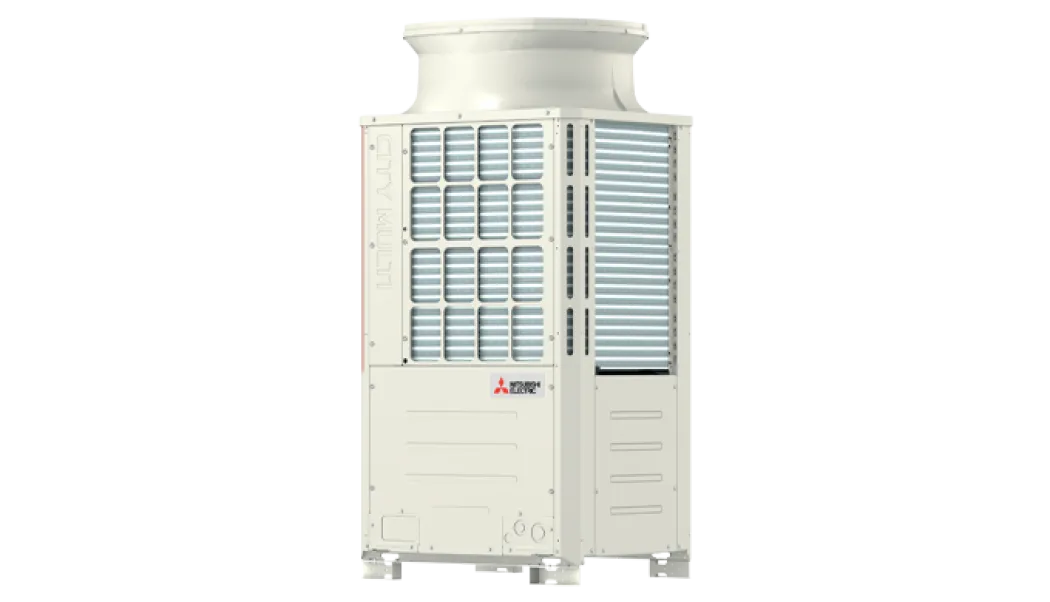
Air source heat pump PURY-P-Y NW-A2
Line R2 Next Stage


The line R2 Next Stage
adopts a two-pipe refrigerant system, which allows thanks to the BC Controller distributor that is the technological heart of the R2 line of the VRF CITY MULTI system, simultaneous operation in heating and cooling. Each compact outdoor unit uses R410A refrigerant and an Inverter driven compressor for effective control of the energy used. The VRF CITY MULTI R2 line system offers the ultimate in freedom and flexibility in design and use: cooling one zone while heating another. The unique BC Distributor makes simultaneous cooling and heating possible and is the technological heart of the R2 line of the VRF CITY MULTI system.
Technical sheet
4-sided battery


Heat recovery system
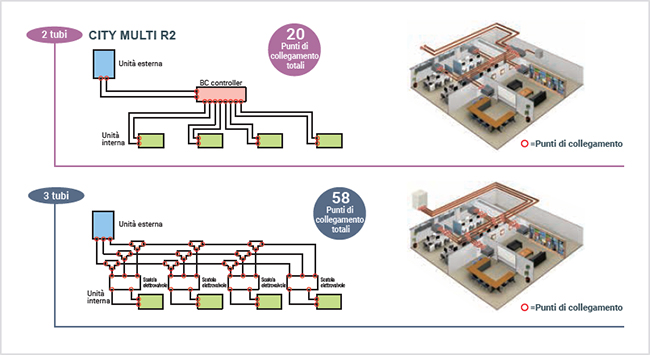
Comparison of systems with different pipe connection points
.
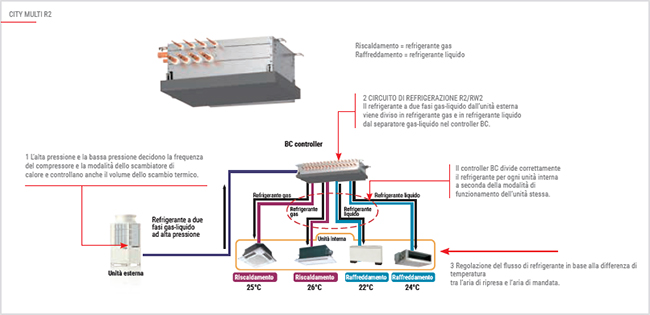
How does the R2 / WR2 heat recovery system work with the two pipes?
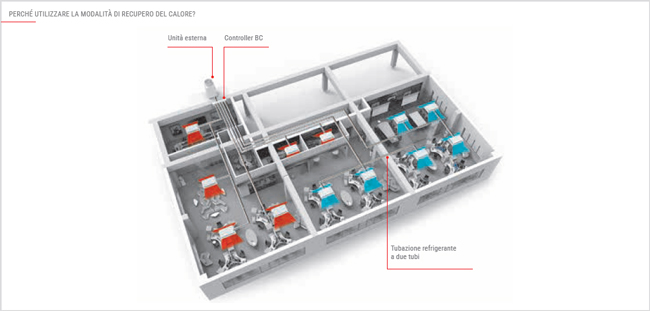
The secret of the VRF CITY MULTI heat recovery system lies in the BC controller. The BC controller contains a liquid/gas separator that allows the outdoor unit to produce a mixture (in two stages) of hot gas for heating and liquid for cooling through the same pipe. Systems with three pipes use one pipe for each of these phases. When it reaches the BC controller, the mixture is separated and the correct phase is sent to each indoor unit according to individual heating or cooling needs.
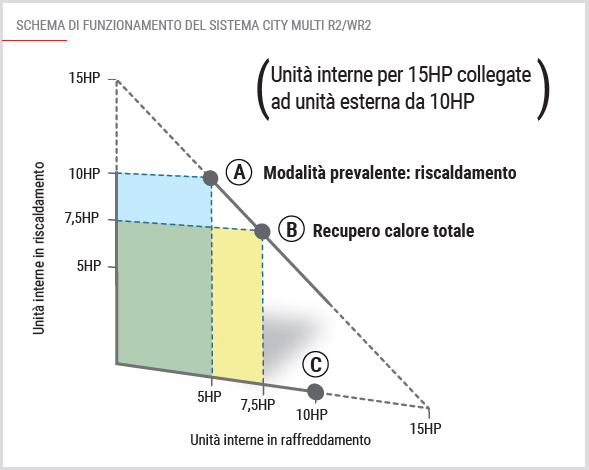
Heat recovery for high efficiency
With the heat recovery system, the more frequently the simultaneous cooling and heating function is used, the higher the energy saving achieved.
Why use the heat recovery mode?
When choosing a system with heat recovery mode, flexibility and effectiveness are key factors. For example, while a heat pump system is suitable for an office with large open-plan spaces, in an office with a structure with more subdivisions, it is necessary to use a system that allows different zones to be heated and cooled at the same time depending on the preferences of individual users. The effectiveness of such a system comes from its ability to use cooling and heating by-products to transfer energy where it is needed, thus acting as a balanced heat exchanger that saves up to 20 percent in operating costs compared with a conventional heat pump system. In addition, the number of connection points required for an R2 / WR2 system is significantly less than that required by a three-pipe system. This reduces installation costs, thereby increasing the savings from the VRF CITY MULTI system.
Continuous heating
Normally, during the defrost phase, the system stops operation by interrupting heat output to the room. However, the continuous heating function makes it possible to perform defrosting of the outdoor unit coil while the system continues to deliver heat output to the room, thus avoiding sharp drops in room temperature.

Continuous heating - single module operation
The heat exchange coil of the outdoor unit is divided into two portions. Even if defrosting becomes necessary, the system can continue to operate using one of the two portions of the coil while the other portion is defrosted.
Continuous heating - operation with combined modules
With combined modules, the system performs defrosting alternately on the different modules that make up the system. In this way, while one module is defrosting the other(s) can (can) continue to deliver heat output to the room.

Evaporation temperature control ETC
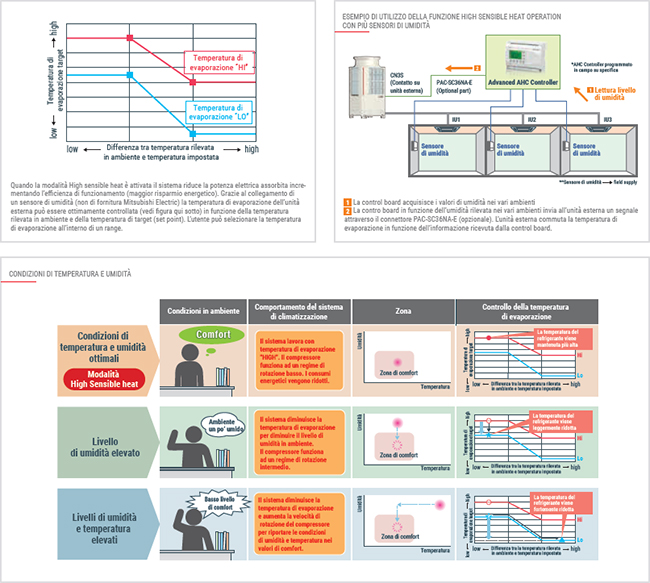
In a conventional system, the evaporation temperature is kept constant regardless of the system load conditions. Under low-load conditions (when the heat loads to be coped with are limited), increasing the evaporating temperature of the system makes it possible to decrease the work to be done by the compressor and consequently limit the electrical absorption of the outdoor unit without affecting the comfort level in the room.
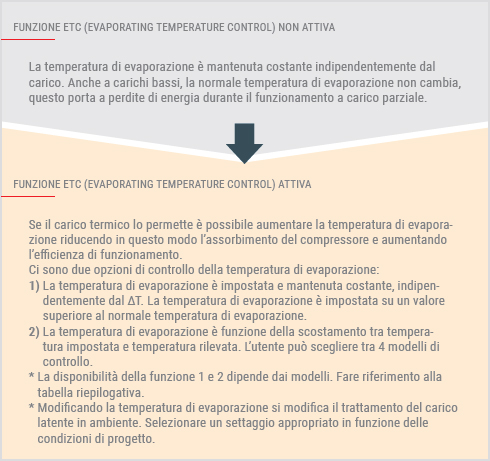

The new outdoor units are equipped with the function for selecting the evaporating temperature that automatically takes into account the system load conditions.

"High Sensible Heat" operating mode
The evaporation temperature can be changed by an external contact (with PAC-SC36NA-E accessory).
Advanced "Low Noise" Function
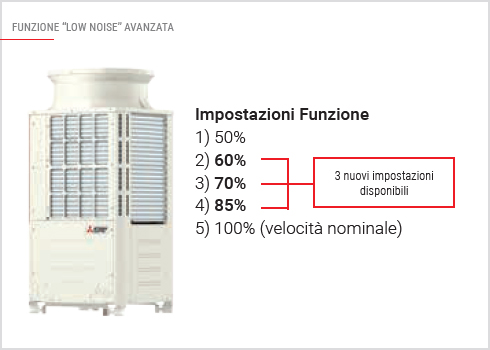
"Low noise" mode can now be selected based on 5 different settings: 85%, 70%, 60% and 50% (values referring to fan speed). Noise attenuation is directly configurable from the control board of the outdoor unit (optional PAC-SC36NA connector required). Different settings can be chosen based on installation requirements (in applications with special noise constraints).
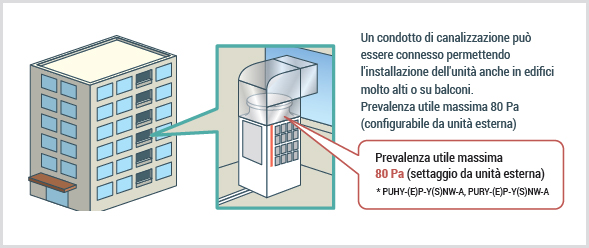
Static fan pressure adjustable up to 80 Pa
The static pressure of the outdoor unit fan can be set between 0-30-60 and 80 Pa. This facilitates the installation of the unit even in locations that require ducting of exhaust air from the fan.
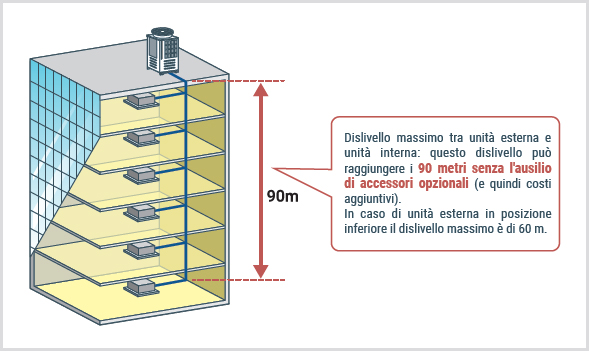
Maximum height difference increased up to 90 meters
Some models of outdoor units have the ability to operate with height differences of up to 90 meters without the adoption of optional kits and thus additional costs. This simplifies and makes design more flexible even in taller buildings.
Extended operating limit in Cooling up to 52°C
In certain types of installation and in areas with high building density, the passage of air can be obstructed. Under very high outdoor temperature conditions and if the air expelled by the unit's fan is not properly moved away the air can stagnate and cause the air temperature around the unit to rise. Thanks to the extended operating range of up to 52°C, the system is able to continue operating without interruption even under these conditions.
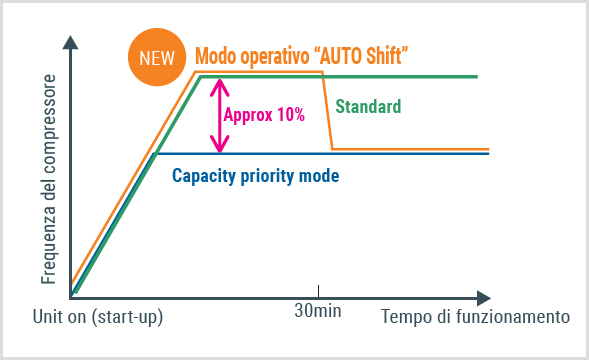
"Auto-shift" mode
The "Auto-shift" mode is a new operating mode that can be set by external unit and is in addition to the two existing modes: COP Priority mode (system operates by maximizing efficiency) and Capacity Priority mode (system operates by maximizing power output). This new operating mode allows the system to operate in Capacity Priority mode for the first 30 minutes and then switches operation to COP Priority mode. Due to this, the system speeds up the regulation time. This mode is an advantage especially during the start-up of the air conditioning system (e.g., when restarting the system early in the morning).
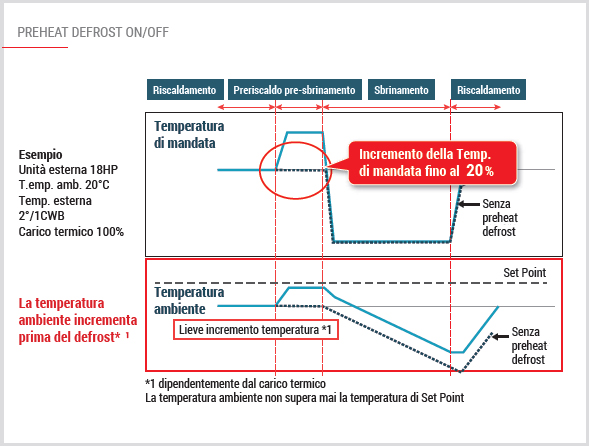
Preheat defrost operation
The new YNW outdoor units are equipped with the Preheat defrost function (which can be activated from the outdoor unit) that increases the air supply temperature before the system performs defrosting operations (typically during defrosting, indoor units deliver air at a lower temperature) so as to "calm" the slight temperature drop in the room during defrosting.
Emergency Function (Backup)
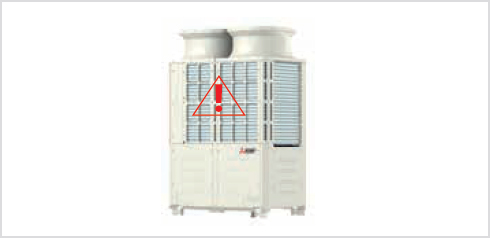
Combined Modules of CITY MULTI outdoor units provide an excellent level of reliability with the new Emergency (Backup) function, which can be easily activated from the remote control of any indoor unit in case of system malfunction. The emergency function guarantees an average cooling and heating operation of 4 hours.
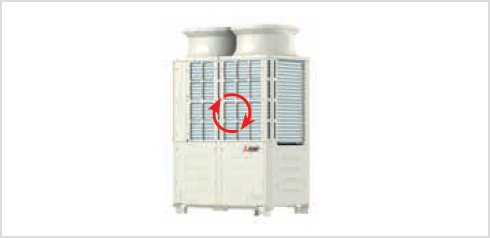
Rotation function
Combination modules of CITY MULTI outdoor units employ an automatic routine called "Rotation Function," so as to ensure a balance of outdoor unit utilization and consequently an optimal life cycle for all system components.
Mitsubishi Electric puts the best professionals at your service to advise you in your choice and guide you through all the steps of purchase and installation.
Find a resellerYour home is unique and deserves a perfect solution. Can we help you find yours?
Let us suggest you